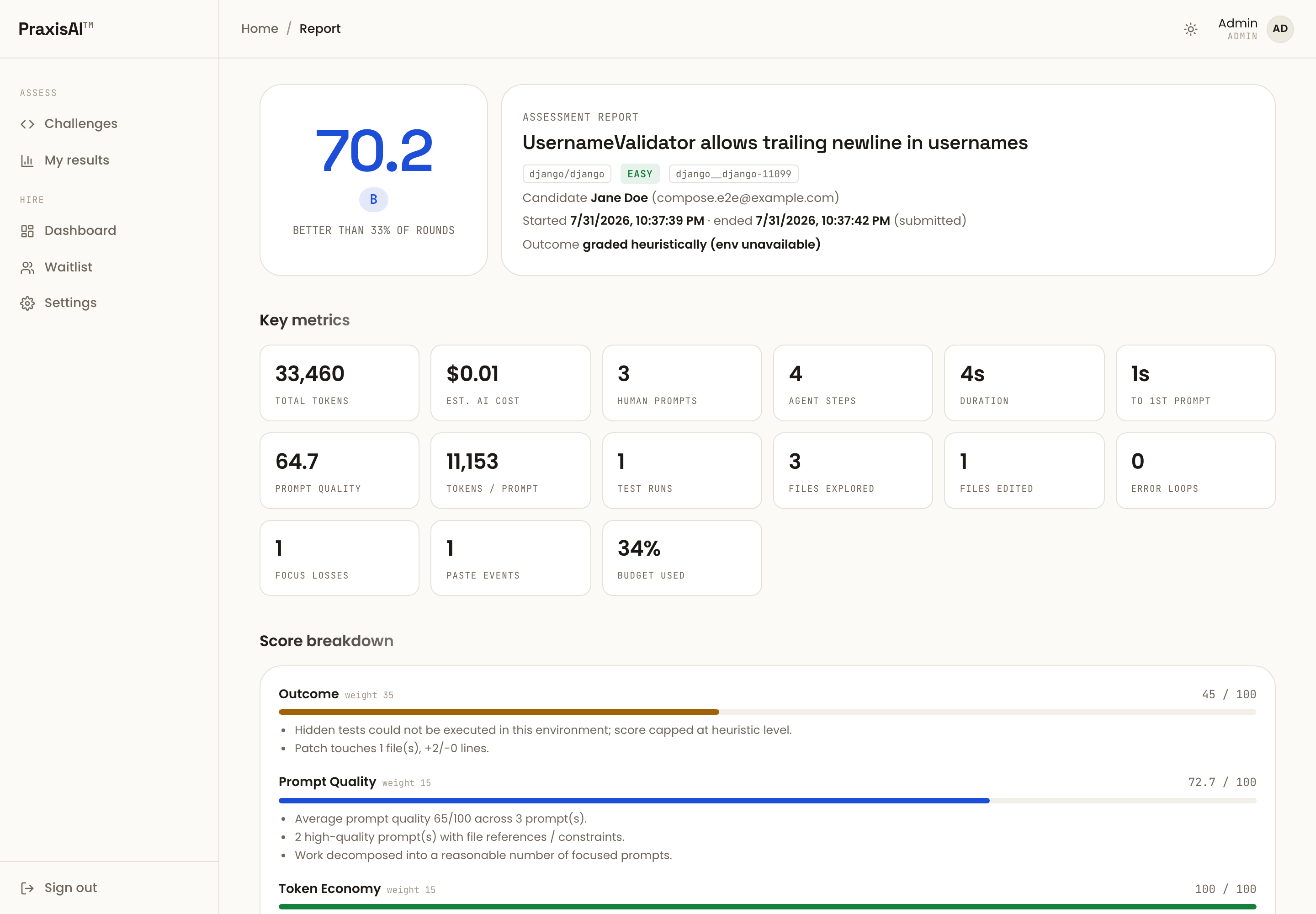
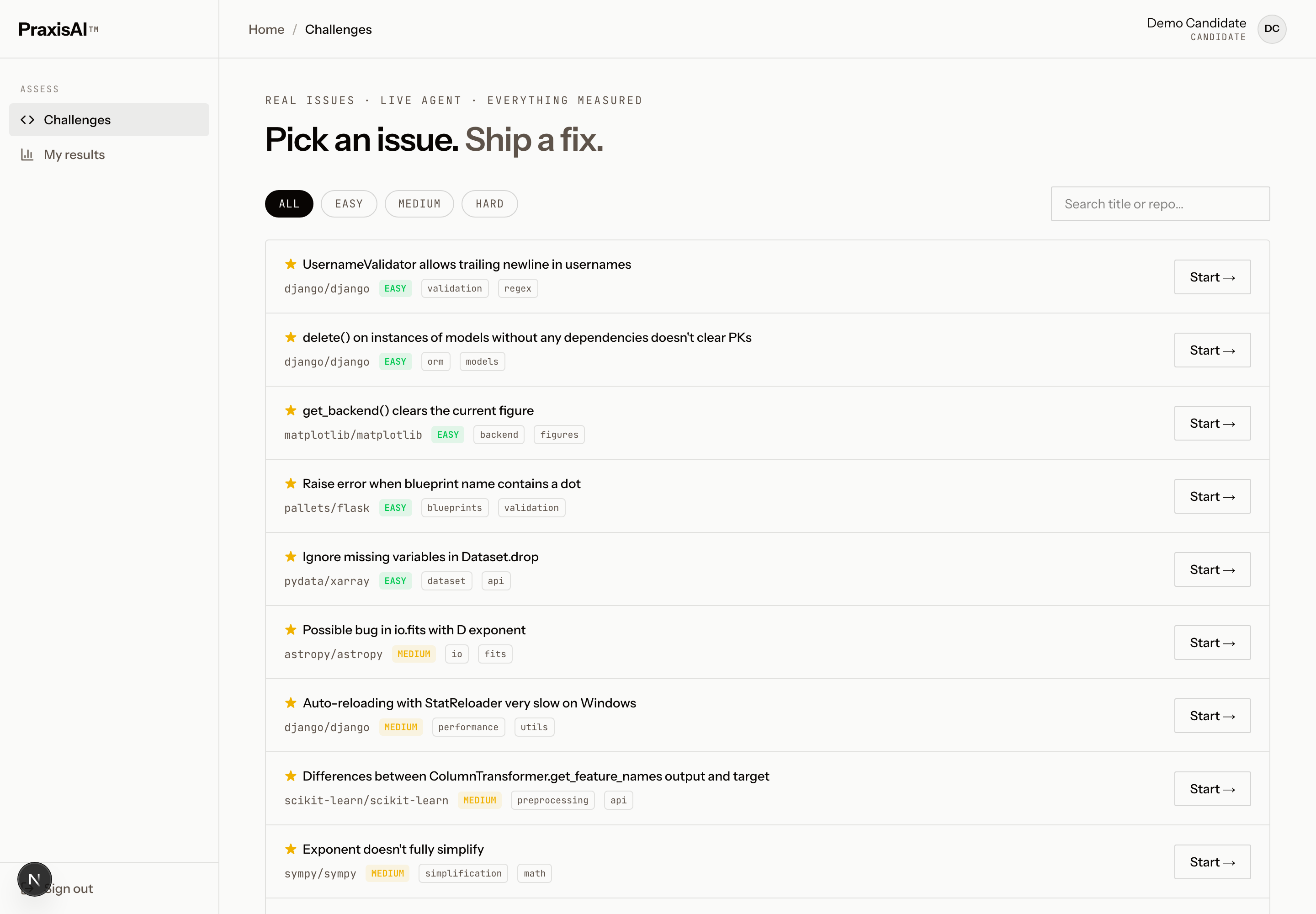
Graded practice rounds include a free score, verdict and test outcome. A paid plan adds the detailed breakdown, prompt coach and replay of recorded events. Explore a sample before signing up.
Read recorded prompts and their attributed tokens. The prompt coach suggests rewrites for patterns such as raw-error pastes, code dumps and vague retries.
02
Scores with evidence
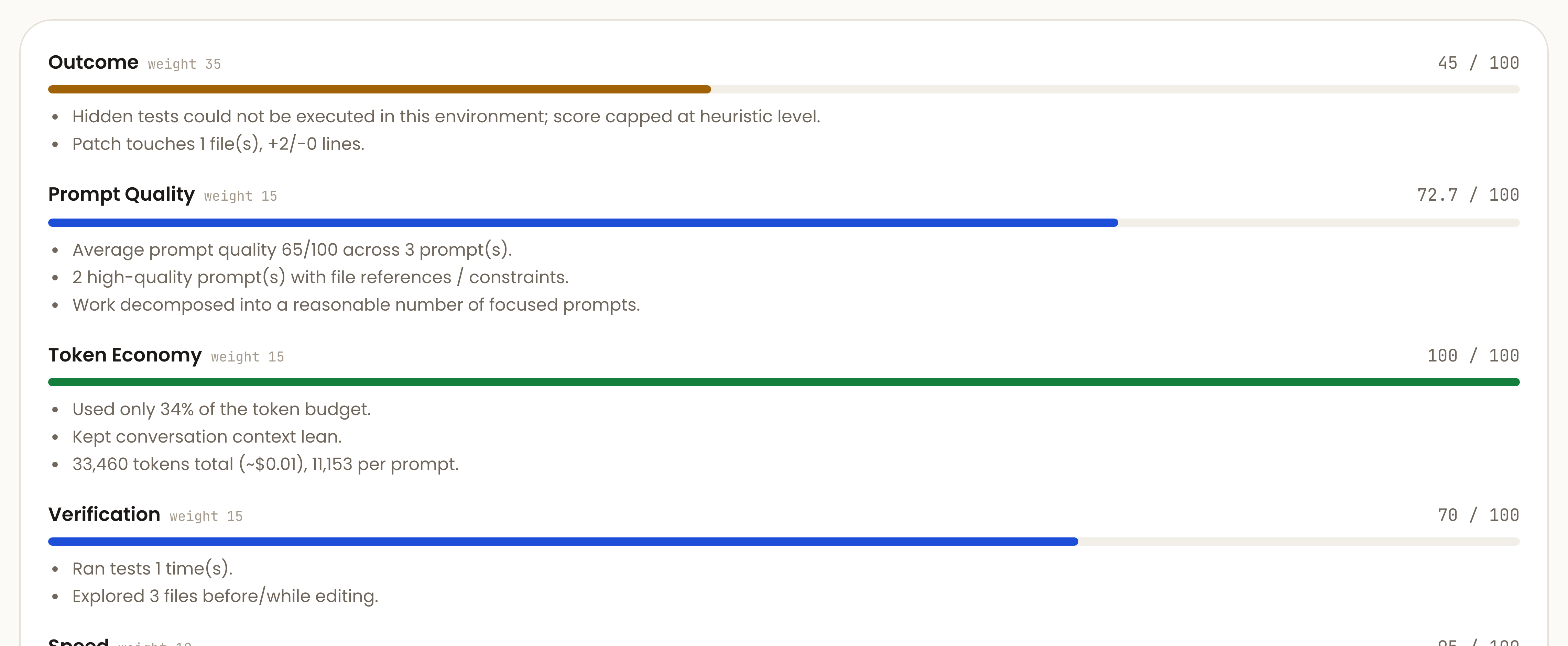
Six weighted dimensions list the observations behind the score. Review rule-based feedback on the recorded process alongside the test outcome.
03
Recorded-event replay
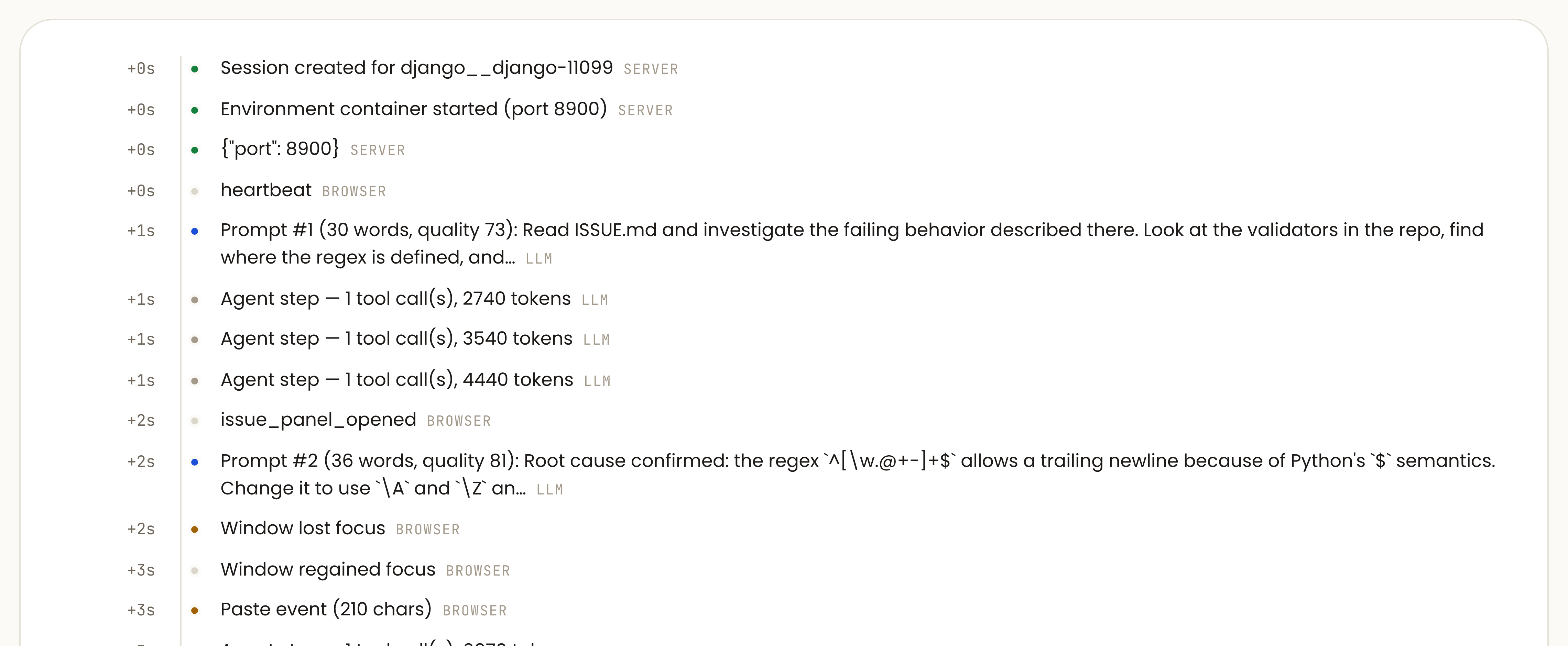
Step through recorded prompts, agent actions and test results on a shared timeline. Revisit a failing run or a retry loop when timing data is available.
04
Token use and testing
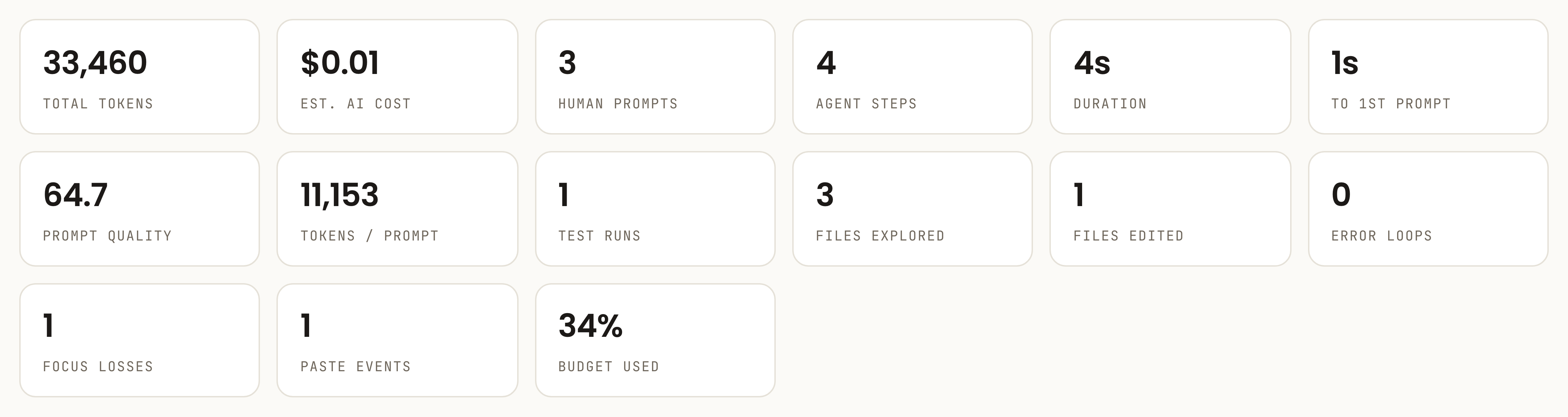
Review token use, provider cost, test cadence and error loops alongside the outcome. Choose a specific change to try in your next practice round.
Two ways to practice
Real work, not puzzles written for an interview.
01 · CHALLENGES
Fix a real bug in a real codebase
Hundreds of GitHub issues from SWE-bench (Django, Flask, SymPy and more), checked out at the exact commit where they were still broken. You get a timer, a token budget and an AI agent; the hidden tests decide whether you fixed it.
The take-home, practiced properly. Start from an empty repository and a written brief, with the rubric and the automated checks shown up front, and build a small product with the agent at your own pace inside a 24-hour window.
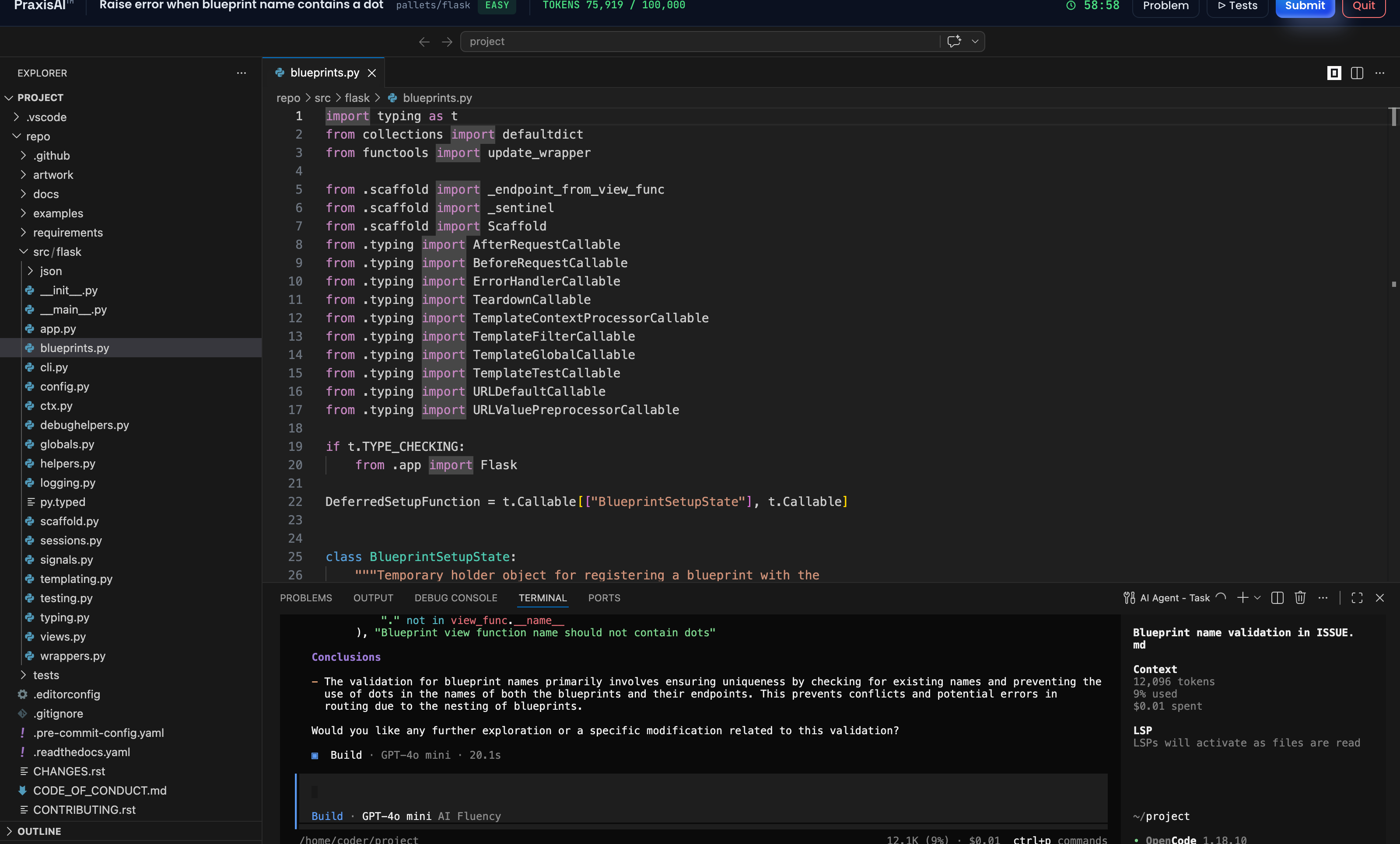
A browser IDE with an AI coding agent, a timer, a token budget and test controls. Read the repository, direct the agent and check its changes.
02
The process report
Free accounts see the score and verdict for graded practice rounds. A paid plan unlocks the detailed breakdown, prompt coach and replay of recorded events.
03
The task bank
Browse available issues from the SWE-bench benchmark. Each practice environment starts from the repository's pre-fix commit.
What you get back
A hiring team's read of your round.
Every graded round gets a Hireability score and call, seven behavior scores with the evidence behind each, and what a reviewer would flag. This preview is from our sample report, a simulated round on a real Django issue.
Solved the issue (2/2 hidden tests); strongest on code quality (100), weakest on steering the AI (22).
A signal, not a decision.A signal to inform a person's hiring decision, not an automated decision. Read the evidence and talk to the candidate before deciding.
Blends seven behavior scores (75%) with the hidden-test outcome (100/100, 25%). Calls: 85+ strong hire, 70+ hire, 50+ lean no; held back by red flags and by work that did not land. Method.
Problem understanding53/100
−Opened by pasting the issue text into the agent instead of framing it.(at 1:34 · prompt #1)
+Corrected the agent 1 time, e.g. #2: “No, that just moves the hardcoded cutoff from 70 to 50. The…”(at 4:42 · prompt #2)
Verification91/100
+Ran the tests 12 times, checking as they went.
+Finished on a green test run.(at 29:42)
Debugging28/100
−Met a failing run with “still failing, fix it” instead of a diagnosis (#4, #5).(at 11:44 · prompt #4)
−The agent failed 5+ times in a row and was left to retry (1 loop).(at 5:45)
Code quality100/100
+A focused change: 28 lines changed across 2 files.
+Kept the fix to 1 source file.
Efficiency81/100
−10% of tokens burned inside failing loops.
+315,299 tokens ($0.17, 16% of the budget).
Ownership and communication75/100
+Explained the change in a 126-word debrief.
+The debrief names the code they changed (http).
+What they do well
Verification
Ran the tests 12 times, checking as they went.
Problem understanding
Read 5 files in the codebase.
Debugging
Worked through the failures to a green run.(at 17:58)
Ownership and communication
Explained the change in a 126-word debrief.
−Where they go wrong
Problem understanding
Opened by pasting the issue text into the agent instead of framing it.(at 1:34 · prompt #1)
Debugging
Met a failing run with “still failing, fix it” instead of a diagnosis (#4, #5).(at 11:44 · prompt #4)
Problem understanding
Did not reproduce the failure before changing code.
Debugging
The agent failed 5+ times in a row and was left to retry (1 loop).(at 5:45)
How they code
Reads before writing, delegates by pasting, tests in tight loops, and corrects the agent when it drifts.
Reads before writing · Opened 5 files; first edit at 2:38.
Delegates by pasting · 33% of prompts were mostly pasted errors, code or issue text.
Tests in tight loops · 5 edit-then-test cycles, 12 test runs.
Corrects the agent when it drifts · 1 course correction.
!Red flags
None: no pasted answers, test tampering or unsupervised agent runs were found.
Why not just LeetCode?
Puzzles train algorithms. This trains the job.
Algorithm practice is still worth doing. AI coding interviews ask something else: can you get a real change landed in an unfamiliar codebase with an agent, and show your work?
Topic
Algorithm puzzle practice
PraxisAI
The problem
Self-contained algorithm puzzles with a short spec.
Real GitHub issues in real open-source repos, checked out at the commit before the fix.
How you work
You write the solution yourself, usually from a blank function.
You work with a real AI coding agent in browser VS Code: read the code, steer the agent, run the tests.
What you get back
Pass or fail on the test cases.
Hidden tests from the merged fix, plus a hiring-team read of how you worked: steering, verification, debugging and cost.
The problem
Algorithm puzzle practice
Self-contained algorithm puzzles with a short spec.
PraxisAI
Real GitHub issues in real open-source repos, checked out at the commit before the fix.
How you work
Algorithm puzzle practice
You write the solution yourself, usually from a blank function.
PraxisAI
You work with a real AI coding agent in browser VS Code: read the code, steer the agent, run the tests.
What you get back
Algorithm puzzle practice
Pass or fail on the test cases.
PraxisAI
Hidden tests from the merged fix, plus a hiring-team read of how you worked: steering, verification, debugging and cost.
Keep score
Follow your practice history.
Your profile tracks recorded practice, score trends and earned badges. XP counts your best eligible attempt per task; ungraded rounds and empty submissions earn no XP.
Paid plans unlock detailed process reports, prompt coaching and recorded-event replay. Each includes the monthly agent credit shown below. Charges depend on the model-provider cost and usage; one-time top-ups add more agent credit.
≈ 8 full-model rounds a month + 8 free (2 every week)Estimate at about $1.00 a round; heavier rounds cost more and lighter ones less, so treat it as a guide.
Plus your 2 free full-model rounds every week
$8 of metered agent usage every month
All enabled challenges and take-home projects
Detailed process reports, prompt coaching and replay on an active paid plan
Round cost varies with the model and measured AI usage
≈ 15 full-model rounds a month + 8 free (2 every week)Estimate at about $1.00 a round; heavier rounds cost more and lighter ones less, so treat it as a guide.
Plus your 2 free full-model rounds every week
$15 of metered agent usage every month
All enabled challenges and take-home projects
Detailed process reports, prompt coaching and replay on an active paid plan
Round cost varies with the model and measured AI usage
≈ 30 full-model rounds a month + 8 free (2 every week)Estimate at about $1.00 a round; heavier rounds cost more and lighter ones less, so treat it as a guide.
Plus your 2 free full-model rounds every week
$30 of metered agent usage every month
All enabled challenges and take-home projects
Detailed process reports, prompt coaching and replay on an active paid plan
Round cost varies with the model and measured AI usage
Every plan dollar becomes a dollar of agent credit, the same as a top-up, so you never pay extra for the credit. What a plan adds on top is the detailed reports, prompt coaching and replay.
Free
$0
Practice every week, no card.
2 free full-model rounds every week
When weekly rounds and credit are used: up to 4 free-model rounds a day, when available
Paid usage is the recorded model-provider cost × 6. If provider cost is unavailable, the fallback is $1.50 per million tokens. Free-model rounds use a lower-quality model tier and depend on availability. Usage charges appear in your billing history.
PraxisAI is a place to practice coding with an AI agent on real open-source issues and take-home project briefs. You work in a browser IDE, run tests and submit your changes. Graded rounds include a free score and verdict; paid plans unlock detailed reports, prompt coaching and replay of recorded events.
What exactly is a practice round?
Pick an available GitHub issue from the SWE-bench benchmark. Your browser VS Code starts at the repository's pre-fix commit with an AI coding agent, a timer and a token budget. Inspect the code, ask the agent for changes and run local tests. On submission, separate grading tests check your patch. If the grading environment fails, the round is marked ungraded and no overall score is shown.
Is it free?
Signing up and browsing challenges are free. The standard allowance is 2 free full-model rounds each week. After those rounds, available credit pays for full-model usage. When the weekly allowance and credit are used, you can start up to 4 lower-quality free-model rounds a day, when available. Weekly allowances reset Monday at 00:00 UTC; the daily limit resets at 00:00 UTC. Your account shows your remaining allowance.
What does a paid plan unlock?
Free accounts see the score, verdict, test outcome and key facts from graded practice rounds. A paid plan unlocks the detailed score breakdown, prompt coach, timeline and replay where recordings are available, including detail for stored earlier rounds. Starter, Pro and Max each add the monthly agent credit shown in pricing. One-time top-ups add agent credit but do not unlock the detailed reports.
Can I cancel anytime?
Yes. Cancel online in Billing → Manage billing (Stripe's secure portal); you never need to contact us. It takes effect at the end of the current billing period: you keep the plan until then and are not charged again. Payments are not refunded once their credit has been added, except where the law requires, but credit already on your balance stays yours to use.
Can I pay yearly?
Yes. Every plan can be billed annually at 20% off the monthly price, charged once a year in advance. Your plan credit is still added each month, the same amount as on the monthly plan, and unused credit stays on your balance. An annual plan renews automatically every year until you cancel, and we email you a reminder about 30 days before each renewal. You can switch between monthly and annual in Billing → Manage billing.
What happens when I run out?
The standard allowance is 2 free full-model rounds each week, reset Monday at 00:00 UTC. After those, rounds are paid from your credit; a paid round needs at least $0.10 to start and is capped at what your balance covers. With no free rounds and no credit left, you can still start up to 4 free-model rounds a day on a weaker model, when available (resets at 00:00 UTC). Top up or choose a plan to keep going on the full model.
How is usage metered?
Paid rounds deduct the recorded model-provider cost multiplied by 6 from your usage credit. If the provider reports no cost, the fallback rate is $1.5 per million tokens. Round budgets and token use are shown in the workspace, and usage charges appear in your billing history. Weekly free rounds and free-model rounds do not deduct usage credit.
What gets recorded, and who can see it?
The report uses recorded prompts, agent responses and tool calls, edits, test runs, token use and timing. Other candidates cannot read your practice prompts or reports unless you share a report link. Public profiles are optional. Aggregate practice results can appear on the leaderboard and in race comparisons; you can opt out in settings. A company sees assessment reports for rounds it invited you to, rather than your personal practice history.
Is the AI the same as in real interviews?
It is the same browser workspace and AI coding agent that companies use when they assess candidates on PraxisAI. Free weekly rounds and paid rounds run on the full model; free-model rounds use a weaker one. Other companies' interviews use their own tools, so we can't promise an identical setup there.
Do companies see my practice?
No. A company sees reports only for assessment rounds it invited you to. Your practice prompts and reports stay private unless you share a report link or publish your optional public profile. Aggregate results can appear on the leaderboard; you can opt out in settings.
Can't I just let the AI do everything?
The outcome checks whether the submitted changes pass the grading tests. Process dimensions use recorded evidence such as local test runs, prompt patterns and token use. They are heuristic feedback on this round, rather than proof of job performance or a guarantee that a particular prompting style will produce a better fix. Inspecting the agent's changes and running tests gives you evidence to review.
What are take-home projects?
Build-from-scratch briefs with a 24-hour window that begins when you press Start inside the environment. The brief, rubric and check commands are shown up front. You work in an empty repository and submit your changes for a report, with the same free score view and paid report detail as issue practice.
I hire engineers. Is this for me?
The hiring side lives at its own site. Companies can send assessment links, choose tasks and review candidate submissions and process reports. Visit PraxisAI for companies, or contact us.
For hiring teams
Hiring engineers who build with AI?
Send candidates the same real tasks and get back a graded patch plus a minute-by-minute record of how they used the agent. It has its own site.
In this historical Django task, a trailing newline gets past the username validator. Work with an agent and check its patch. Your score and test result are free. Detailed coaching and replay are paid.